AbsoEnergy
Russia
Since 26.09.2026 a home can feed up to 50 kW into the grid, and a business or an apartment building up to 150 kW; solar on the roof of an apartment building has become common property. But the surplus is bought cheaply — about 3–3.6 ₽ per kWh in the European part — and tariffs differ fourfold between regions. The main arguments are backup for outages, the south and homes without gas.
Rules
From laws, government resolutions and regulators’ orders; checked 02.11.2026.
Microgeneration
A microgeneration facility is a system for your own needs that runs in parallel with a grid of up to 1,000 V (Federal Law 35-FZ, Article 3, clause 42, as amended by 471-FZ). Law 208-FZ of 26.06.2026 replaced the old 15 kW limit with caps set by the government and allowed microgeneration as part of the common property of an apartment building.
Government Order No. 2675-r of 26.09.2026: export to the grid of up to 50 kW for individuals and up to 150 kW for sole proprietors, companies and the common property of apartment buildings, but no more than the consumer’s own maximum capacity.
- Connection only to grids of up to 1 kV
- A system on an apartment building that serves more than one unit is common property (Resolution No. 1242)
- At the end of 2025 Russia had 1,123 microgeneration facilities with 12.4 MW in total (ARVE)
Sources (6)
- 471-ФЗ от 27.12.2019 — объект микрогенерации · 27.12.2019
- Федеральный закон от 26.06.2026 № 208-ФЗ · 26.06.2026
- Распоряжение Правительства РФ от 26.09.2026 № 2675-р — пределы выдачи микрогенерации · 26.09.2026
- Правительство России: увеличены лимиты выдачи электроэнергии в сеть · 28.09.2026
- ppt.ru: постановление Правительства РФ от 26.09.2026 № 1242 · 26.09.2026
- АРВЭ: годовой обзор рынка (микрогенерация) · 2026
Selling the surplus
You apply to the grid company the house is connected to; the contract with the guaranteeing supplier (the regional retail supplier) appears in your online account within 10 working days. The meter is hourly and bidirectional.
The guaranteeing supplier pays the wholesale price: the day-ahead market plus capacity. An example — Tambov, June 2025: 3.56 ₽ per kWh, about 40% of the Moscow tariff. So using the sun yourself pays more than selling it.
- Income from selling the surplus is exempt from personal income tax until 01.01.2029 (Tax Code of Russia, Article 217, clause 28.1)
- The supplier may deduct a debt for energy consumed from the payment for the surplus
- We have not found the buy-back price for Siberia and the Far East
Grid connection
For a home of up to 15 kW the connection fee is preferential: the region sets a rate per kW of no less than 5,000 ₽ excluding VAT. In Moscow in 2026 it is 6,522 ₽ per kW including VAT, so about 98,000 ₽ for 15 kW; for preferential categories — 1,304 ₽ per kW.
Timing — from 30 working days near a 0.4 kV line to 6 months; if the house is already connected, microgeneration is added in about a month.
- We have not yet found the preferential fee and timing for 15–50 kW microgeneration after 26.09.2026
Tariffs and volume bands
The 2026 indexation was moved to 01.10: the base tariff rose by about 11.1–11.3%, and from 01.01 it had already gone up by 1.7% because of the 22% VAT. In 2025 the increase was 12.6%.
Since 2026 almost every region has to split the tariff by volume: up to 3,900 kWh a month at the preferential rate, 3,900–6,000 at a higher one, over 6,000 at no less than the tariff for other consumers. In Tatarstan that is 6.47 → 8.54 → 12.41 ₽. Solar and a battery that cut off the top kWh pay off faster there.
- Moscow: no bands; at night (23:00–07:00) — 4.85 ₽
- Homes with electric heating in winter: thresholds ×1.8 — 7,020 and 10,800 kWh
Sources (5)
- Профиль: индексацию тарифов в 2026 году перенесли на 1 октября · 31.10.2025
- Приказ ФАС России от 19.12.2025 № 1130/25 — предельные тарифы для населения на 2026 год · 19.12.2025
- Основы ценообразования (ПП РФ № 1178), п. 70 — диапазоны по объёму · 22.10.2026
- Татэнергосбыт: тарифы · 02.11.2026
- ДЭПиР Москвы: приказ от 24.12.2025 № ДПР-ТР-407/25 — тарифы для населения · 24.12.2025
Incentives
We have not found federal subsidies, grants or soft loans for private solar systems, batteries, heat pumps or home chargers — only the 0% personal income tax on surplus sales. So the calculators count without any top-ups.
For electric cars: 0% transport tax in Moscow until 01.01.2030 and in a number of regions, free parking in Moscow’s paid city car parks; charging at city hubs costs 20 ₽ per kWh, 14 ₽ at night.
- Subsidies for fast charging stations go only to companies; there are none for home chargers
The house and the codes
Whether a system on the roof of a private house needs a permit, and which codes apply to home lithium batteries, we check for each property during the site survey: we have not yet found general rules with a primary source.
We install only certified equipment, put the battery in a warm room with fire separation and design the mounting for the local snow.
Household tariffs from 01.10.2026
Single-rate tariff including VAT, ₽ per kWh: a city with gas stoves, and homes with electric stoves or electric heating. Where the regional order would not open, the table shows the upper limit of the FAS range: in the regions we checked, the tariff equals it.
Nizhny Novgorod Region — the tariff within the social consumption norm; above it — 10.00 ₽. Irkutsk: the supplier charges 2.10 ₽, the FAS upper limit is 2.00 ₽. In regions with volume bands — the first band (up to 3,900 kWh a month). Gas — for heating, by meter; in Krasnodar Krai the price is the one for Krasnodar, and for Sochi the krai-wide one.
Sun by city
Southern Russia gets as much sun as Germany; eastern Siberia and Primorye get more than Moscow: they have many clear winter days.
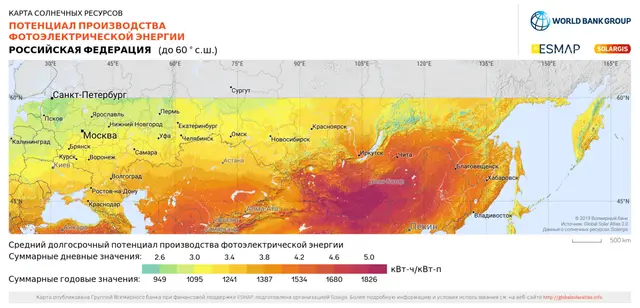
| City | Best tilt, kWh a year | Flat, 10° | Per day, kWh | Database, tilt |
|---|---|---|---|---|
| Moscow | 968 | 864 | 0.6–4.3 | PVGIS-SARAH3, 41° |
| Saint Petersburg | 907 | 802 | 0.2–4.6 | PVGIS-SARAH3, 43° |
| Nizhny Novgorod | 1,036 | 915 | 0.5–4.7 | PVGIS-ERA5, 42° |
| Kazan | 1,109 | 976 | 0.6–5 | PVGIS-ERA5, 42° |
| Samara | 1,196 | 1,054 | 0.9–4.9 | PVGIS-ERA5, 42° |
| Rostov-on-Don | 1,211 | 1,117 | 1.1–5.1 | PVGIS-SARAH3, 36° |
| Krasnodar | 1,240 | 1,145 | 1.6–5 | PVGIS-SARAH3, 36° |
| Sochi | 1,244 | 1,147 | 1.8–4.9 | PVGIS-SARAH3, 35° |
| Volgograd | 1,209 | 1,103 | 1.1–4.9 | PVGIS-SARAH3, 37° |
| Astrakhan | 1,291 | 1,183 | 1.4–5 | PVGIS-SARAH3, 38° |
| Makhachkala | 1,190 | 1,114 | 1.6–4.7 | PVGIS-SARAH3, 34° |
| Yekaterinburg | 1,101 | 940 | 0.9–4.7 | PVGIS-ERA5, 45° |
| Novosibirsk | 1,203 | 1,039 | 1.1–5 | PVGIS-ERA5, 44° |
| Irkutsk | 1,426 | 1,176 | 2.1–5.3 | PVGIS-ERA5, 48° |
| Ulan-Ude | 1,504 | 1,233 | 2.5–5.5 | PVGIS-ERA5, 48° |
| Vladivostok | 1,521 | 1,288 | 3.2–5.4 | PVGIS-ERA5, 45° |
PVGIS 5.3, 14% system losses. For Da Lat the PVGIS optimiser gives an odd tilt, so the best option there is a flat roof at 10°.
Sun and climate: PVGIS 5.3, Joint Research Centre of the European Commission — PVGIS © European Communities, 2001–2026.
What is relevant in Russia
Our assessment based on climate, tariffs, rules and prices as of 02.11.2026.
| Solar panels | case by case | The south gives 1,200–1,300 kWh per 1 kW a year — as much as Germany; Moscow about 970, Saint Petersburg about 900. On the household tariff the payback is long; the strong cases are the south, dachas with a weak grid, and backup together with a battery. Since 26.09.2026 a home can feed up to 50 kW into the grid, but the surplus is bought at the wholesale price — about 3–3.6 ₽ per kWh. |
|---|---|---|
| Inverters | relevant | The main choice is a hybrid with real backup, not “one socket in the daytime”: outages are the main reason in Russia. Install it in a heated room or pick a model rated for frost in its datasheet. |
| Battery storage | relevant | The main argument in Russia is outages: the boiler, pump, fridge and internet keep working for hours and days. Install it in a warm room (a boiler room, a basement) with fire separation: in frost, charging is limited. |
| Heat pumps | case by case | The heating season lasts from 130 days in the south to 230 in Siberia, with frosts down to −36 °C (our calculation from ERA5). A heat pump pays off where there is no mains gas: instead of an electric boiler, LPG or diesel. It needs spare grid capacity. |
| Solar water heaters | case by case | For a dacha and the summer season it is a good, simple option. In winter it needs a pumped layout with antifreeze, and the solar share is small. |
| EV charging | case by case | The charger type follows the car: Type 2 or GB/T. You need spare capacity on the grid connection, and often load balancing with the rest of the house. |
| Smart energy management | case by case | Households have day/night time-of-use tariffs: a HEMS moves water heating, charging and the heat pump to the night and to sunny hours, and keeps a reserve in the battery before bad weather. |
| Generators and backup | relevant | The main backup for homes with frequent outages and for winter. The “generator + battery + hybrid inverter” combination cuts engine hours, noise and fuel. |
| Small wind | rarely | The average wind at 10 m in Russia’s large cities is 1.8–3.6 m/s (our calculation from ERA5): too little for a turbine. It makes sense on remote open plots by the sea and in the steppe — together with solar and a battery. |
| Small hydro | rarely | Mountain and hill plots with streams. In winter — ice: a sunken intake and an insulated pipeline; the use of the water has to be registered. |
| Hydrogen for the home | rarely | There is no market and no service for homes: we do not offer it as a product and keep an eye on how it develops. |
| Audit and energy saving | relevant | Winter is long: insulation and heating controls pay off every year. Thermal imaging is done in winter. |
Climate
Winter and summer
In Moscow 1 kW gives about 20 kWh in December and about 130 in June: 6–7 times more. Eastern Siberia and Primorye are sunnier: in Irkutsk and Ulan-Ude 1 kW gives 1,400–1,500 kWh a year, in Vladivostok 1,520 (PVGIS, ERA5 reanalysis). Backup and off-grid systems are sized for December.
Sources (1)
Snow
A steep tilt and clearance from the ground make the difference: in Michigan, modules on racks lost 5–12% of their annual output to snow, and modules right at ground level 29–34%. Mounting is designed for the local snow load.
Sources (1)
Frost
The coldest five-day period, by our calculation from ERA5: Moscow −24 °C, Kazan −28, Yekaterinburg −29, Novosibirsk −36, Irkutsk and Ulan-Ude −32, Krasnodar −14, Sochi 0 °C. A heat pump here needs a cold-climate range and top-up heating, and a battery needs a warm room: in frost, charging is limited.
Wind
The average wind at 10 m in large cities is 1.8–3.6 m/s (ERA5, 2005–2023): too little for a small turbine. It makes sense only on open plots by the sea and in the steppe.
Request in Russia
A house, dacha, café or farm — we’ll calculate it on your region’s tariff and choose backup for outages.